Lessons from a writer who has fought to reach The End (twice).
Revision Reflection: 03
I’ve struggled with unraveling the emotions I have surrounding finishing the second draft of my novel and conquering the major rewrite that was my ACT Three. I feel like a changed writer from Draft One, even more so, a changed writer from the edits made in each ACT of this second draft.
The final ACT of this novel challenged my characters through every hardship I had thought they needed to walk through to achieve the reflections made at the end. There were breakups, disownings, and surprising wins that quickly followed heart-wrenching losses for some and death for others. There was clarity on the possibilities that could be created, and fear of the unknowns that lingered throughout their transformations.
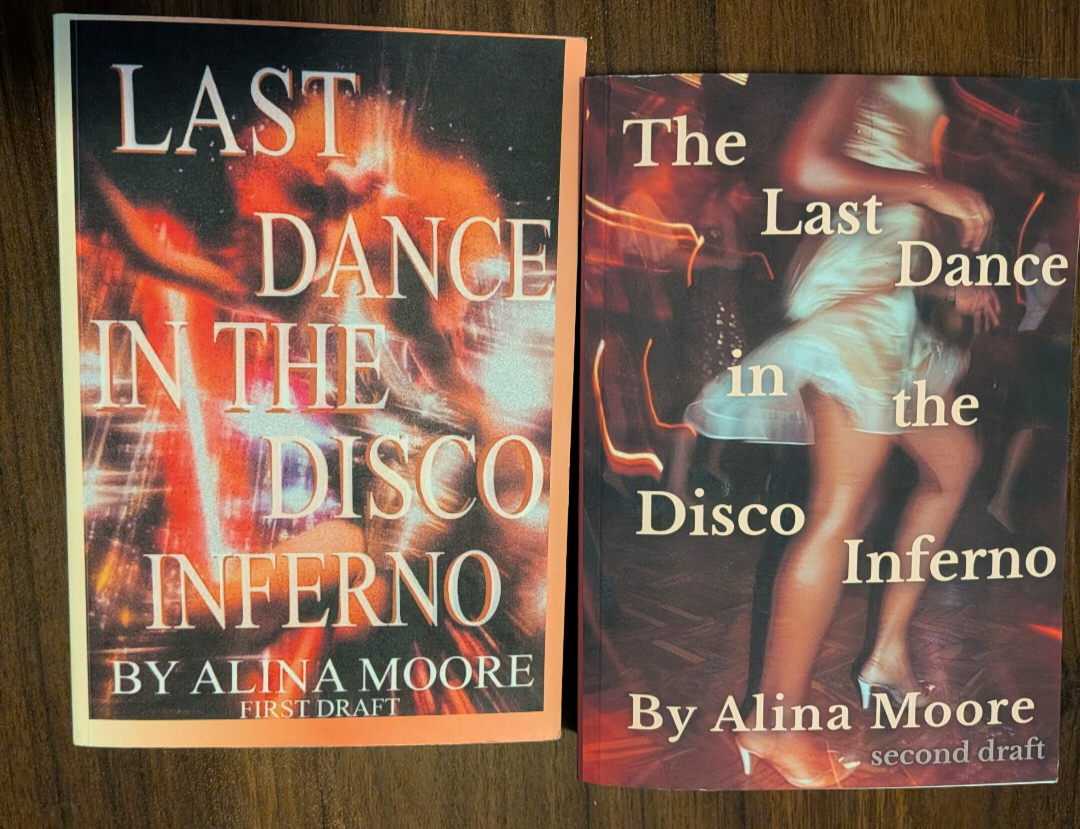
First Draft (Left) and Second Draft (Right) Covers I made to get a printed copy
I knew the end of this novel was a major emotional task, and I wasn’t sure I could carry it through. But by forcing my characters to face their aching pains, I was able to see where my own pains were harboring. My emotions were more intense during this drafting stage, which made it more difficult to go to the page each day to write these past few months.
But as I saw the end of this story near, I knew I needed to be in a space that allowed me to seclude into this fictional world, to feel as the characters felt, to immerse in their tragedies and healing, with no barriers or excuses stifling that process. I physically needed a change of scenery to write the ending. So I booked myself a solo writing retreat for a two-night stay in a treehouse studio in Springfield, and I am so grateful I did!
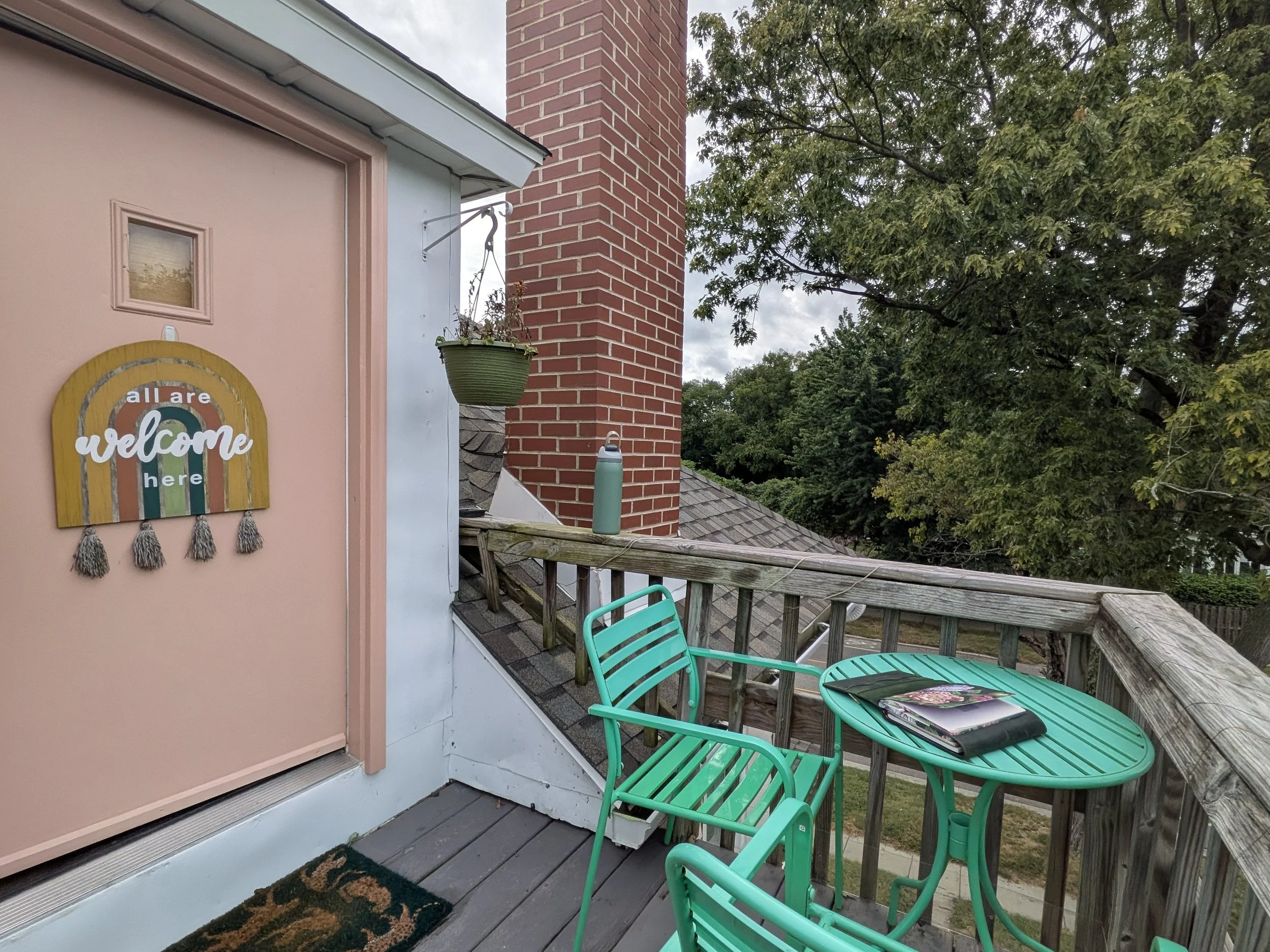
Finding Answers In The Trees
I felt immense anxiety immediately as I entered alone into the unfamiliar space. I didn’t feel the torturous comforts of the excuses that prevented me from facing The End. I journaled, walked the neighborhood, then recentered myself back to the task at hand: to experience the beauty in someone telling their story. For those 48 hours, I was able to flow into my story’s world with no distractions, pacing my writing in a way that honored my creative self, and allowed the book to speak on its own without outsider noises.
When I first started revising this draft, I thought I should be able to say why this story was an important read by the time I finished it. To have proclaimed and proved why this story mattered, why it was worth the read. But once finishing, I recognized I was asking the wrong questions of this manuscript.
The ending isn’t asking why the story was important. But rather which emotions were most important to feel?
Questioning which messages by my characters and their world were most difficult to say but were present through every moment of their journey? As the writer, the only answer to that question was through discovery, is by writing, repeatedly, to find it. I hate that that’s the answer, but it’s the right answer for this stage of creation.
I stopped asking myself why my book is important. Because a book’s importance is always relative; and important to whom? I shifted to discovering what it was trying to tell me. Through my characters’ actions, through where the story’s scenes wanted to take place, and the conflicts that arose from that. Exploring what those moments meant to those characters and, by reflection, what those moments mean to me. And I think through that exploration and discovery, it showed me the importance of why the story needed to be told in these specific ways. (btw thank you to my girl Nikki J. for broaching these types of convos/insights with me. Keep writing girl, you’ll find the answers! ❤️)
With the immense responsibility to be in conversation with this story, I was able to get to the end of it, 10 months later, with an answer, an understanding of what the book is saying it is.
A story of fighting with and living as your truest self.
In the final night of my stay in this treehouse studio, I wrote just under 5,000 words total, finishing the whole draft at 89,865 words! (532 pages-A5 size)
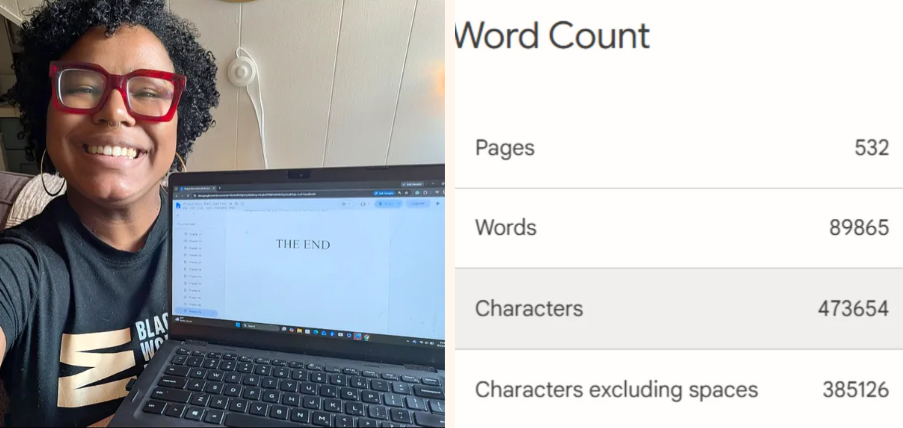
I finished my draft, then cried. For many reasons.
I cried with panic because of the unexpected emptiness I immediately felt from having no more words to give to the story. I cried with joy for having the strength to prove to myself I can find the answers even when I felt my weakest.
I cried with empathy for the long journey my characters had to persevere through, then chuckled at being the one who did it to them. Only to see their revenge in the increased number of words/chapters future Alina would be left to revise.
But I see what this story is now! And that is my true reward for finishing this second draft. The castle is built, and its crest has formed! I can now make my plans to oil each hinge of the openings and closings it has at the foundations, to hopefully get inside and decorate with my own beauty and style next.
But as the year closes out, I’m taking these final months of 2026 to rest, to reflect, to process, and to hope for the future of what this story can look like. And I hope you join me and follow along to find out its possibilities as well.
The TLDR
Hey! I’m Alina. I’m a Black lesbian writer and poet from Chicago. I’m currently on the exciting, yet trying, adventure of writing my first full-length novel that I aim to get traditionally published!
The Last Dance In The Disco Inferno
〰️
The Last Dance In The Disco Inferno 〰️
* Elaine “Dayna Darkness” Sims was the rising queer disco dancing queen of the 70’s—until she vanished. For decades, the reclusive former starlet traded the glitter of the disco ball for a life of isolation, never sharing why.
Tori Robinson has left her home in New York as her BIPOC curation nonprofit had crumbled, destroyed by her ex-co-founder’s fraudulent dealings. The opportunity to rebrand with a Chicago University fellowship exhibition motivates her to find a showstopping story to archive and distance herself from the threats her ex-co-founder claims to further falsify Tori’s reputation.
Archival photos lead Tori to Elaine’s doorstep with a career-changing mission for them both: a tell-all showcase of the icon’s life and a chance for Elaine to return a promise she long broke.
Both women are eager to protect their legacies, as Elaine’s labyrinth of dark memories ignites Tori’s own hidden fears. Together, their reflections on lost love, scandalous betrayals, and life-ending tragedies force them to ask: Do you still perform when there’s no one left? Who gets to tell your story?
The only thing for certain is that the truth is the only thing that doesn’t burn in the disco inferno.
*working synopsis
Revision Reflections: 02
THE TLDR
I am currently on the exciting, yet trying, adventure of writing my first full-length novel that I aim to get traditionally published!
Project Disco a.k.a The Last Dance in the Disco Inferno tells the story of reclusive former starlet Elaine ‘Dayna’ Sims, spending the past three decades hiding from the glitter and grit of her past, when she’s unexpectedly approached by ambitious curator Tori Robinson, on her own costly rebrand undertaking, to archive Elaine’s life for a new exhibition. A dangerous dance of memory and mirrors begins as ghosts of Elaine’s disco era resurface, and the deep shadows of New York City threaten Tori’s exhibition. Are the secrets they’ve kept to protect their reputations worth more than the cost of the truth? For this final performance, they must decide to preserve the legacy of a public persona or reveal the truths behind the curtain.
In the disco inferno, the truth is the only thing that doesn’t burn.
On Fighting the Beast
I’m officially done with the second revision of ACT II in my current WIP, The Last Dance In The Disco Inferno, meaning I’m creeping towards the end of this draft, and I can’t believe how this journey has been taking shape thus far.
ACT II was just as difficult and all-consuming as the first time drafting. It’s like I’ve been squaring off in the ring with a beast that is solidifying its form, and some days I win as its creator, other days it knocks me out so hard, my eyes cross, and my mind jumbles from the task at hand.
In this second draft, I knew this section of the story would be difficult because I was approaching a complete restructuring of one of the timelines/POV’s. Having re-brainstormed and re-plotted the main conflict in one of the major storylines, I knew that this part of the draft would involve heavy mental gymnastics to not only heighten the stakes but also merge and twine the pieces of the existing elements so that the conflict’s impact would jump off the page.
“We revise—which is to say we write—to understand our intent, to understand our own stories, to understand ourselves-”
— Peter Ho Davies
With a new storyline inputted in the new chapters, I quickly realized this process felt like drafting for the first time again! I had great flow and energy at some points, and during others, the magnitude of the work ahead hit my self-esteem hard. As I was clarifying and evolving one chapter/section that had already been written, I had to shift to drafting another section that felt like I was producing infant words. I deleted so many existing moments, then included many new scenes to expand on Tori’s, one of my FMCs, backstories and character arc. Tori did not have as much depth as my other characters in Draft One, even though she was the driving force in bringing the central story to life. It felt like a puzzling maze that I somehow came out of the other end of, only to stare at the next, impending, larger maze ahead!
I recognize that this part of the writing stage is just the process of creating art. This is the work that is feared by many writers and even avoided by those who refuse to put in the work but expect the rewards.
I stand stronger now than before in tackling this beast because I see the potential of this story and the impact it can have as a whole. My characters are so much more layered than the first draft; their environments and the purpose within their missions are what drive me to the page every day. This draft truly has made me laugh with my characters, and tear up and hurt when they hurt. I know I have many paths to take with them still, but I feel so proud of this reconstruction so far.
Choosing to be an artist means that you have decided you aren’t going to take the easy road.
I accept the beast for what it is. I’m now deep in the cave with it, examining its inner core. And I refuse to give up because of the discomfort of staring it in the eye. A successful artist is one who doesn’t quit. I see the end near, and I see how this work is forming into the larger picture of what storytelling can be.
Cheers to knocking on the doors of this final ACT/end of draft two!
— Alina
Jun 01, 2026
Revision Reflections: 01
THE TLDR
I am currently on the exciting, yet trying, adventure of writing my first full-length novel that I aim to get traditionally published!
Project Disco a.k.a The Last Dance in the Disco Inferno tells the story of reclusive former starlet Elaine ‘Dayna’ Sims, spending the past three decades hiding from the glitter and grit of her past, when she’s unexpectedly approached by ambitious curator Tori Robinson, on her own costly rebrand undertaking, to archive Elaine’s life for a new exhibition. A dangerous dance of memory and mirrors begins as ghosts of Elaine’s disco era resurface, and the deep shadows of New York City threaten Tori’s exhibition. Are the secrets they’ve kept to protect their reputations worth more than the cost of the truth? For this final performance, they must decide to preserve the legacy of a public persona or reveal the truths behind the curtain.
In the disco inferno, the truth is the only thing that doesn’t burn.
ON BEGINNING AGAIN
I’ve been in the midst of revision for Project Disco for the past 3 months, and WOW is this a different experience from writing a first draft. I learned quickly that revision is where the magic happens; it’s where the mold begins to bend and fold into the structure you’ve envisioned all along. I had a clear vision of how I wanted to revise the first three chapters of my manuscript as soon as I wrote THE END on the first draft. The story expanded so much by the end of the first draft that I knew I had a clearer direction for how I needed to introduce characters and conflicts in the beginning, but it still felt so intimidating! I felt the task at hand was too large for me to take on.
“Art happens in revisions” — Leigh Bardugo
As I was working on those beginning chapters, I was reading a book on editing called The Artful Edit: On The Practice of Editing Yourself by Susan Bell, it was the right book at the right time. It examined structural and thematic editorial collaboration done with Max Perkins and writer F. Scott Fitzgerald for The Great Gatsby. I didn’t know that the majority of the chapters would focus on their collaboration, but I decided to rewatch the 2013 film adaptation simultaneously. I was able to visualize, along with the written examples, how certain editorial choices of the story enhanced elements of the plot structure and character arcs that were not there before Max Perkins’s editorial touch.
Now I’m obsessively, more than before, examining books and films’ openings and story structures. I’ve become so fascinated with how beneficial a detailed and passionate editor’s eye can be on a writer’s work.
“If you stuff yourself full of poems, essays, plays, stories, novels, films, comic strips, magazines, music, you automatically explode every morning like Old Faithful. I have never had a dry spell in my life, mainly because I feed myself well, to the point of bursting.” —Ray Bradbury
With the reassurance and promise to myself that I can take my time with this manuscript, that there isn’t a metaphorical gun to my head to get this perfect in one go, I dove in and revamped my ACT I outline. Fleshing out with details and changes I knew I wanted to include, some new chapters and some deleted and meshed together, it all started forming sharper edges to its mold. Now having finished writing/revising ACT I, I can see it’s sooo much stronger, and that much closer to the story I know it’s meant to be.
Now to completely re-outline ACT II. (spoiler, it’s giving me a temporary aneurysm...to be shared in next Revision Reflections)
— Alina
Feb 01, 2026
I wrote a book no one will read
Backstory
I had never really seen myself as a novelist, 7 months ago. When I was younger, I used to enjoy making little stories and reading books. I even won a young authors’ award in 5th grade for a Tom and Jerry-esque story I wrote and illustrated. I wrote about that book and my experience stepping into the light and embracing the title writer in my post Fear of Being Seen Doing What I Love.
Even though I’ve known writing brought me joy, as an adult, I never wanted to take the steps to actually try writing a full-length novel (50k+ words). I have a history of fear of failing. I grew up an overambitious, high-achieving child, teen, and young adult. I hate not being good at something; I despise it truly. But in my mid-20s, I felt lost. I kept exploring different hobbies and interests, but nothing stuck until I found my way back to writing (and then my frontal lobe development hit HARD, y’all.)
Three months before my 30th birthday, something shifted.
The end of my 20s started closing in, and I found my way back to writing. I found poetry. Specifically, I read Renee Watson's Black Girl You Are Atlas at a bar by myself with a glass of red wine, and it sparked my creative soul. Poetry brought a bright light into my life that I never knew was desperately needed. I made 15 poems in the span of 2 months (10 of those being published with magazines and zines now at the time of writing this). I experienced a burst of creative energy like never before.
A story appeared
A few months into 2025, a sunny day in March, I was driving home from work, and was jamming out to Donna Summer- I Feel Love.
A little about me, I LOVE the 70s era, I love black queer culture at that time, and disco music truly brings me joy. I am also VERY gay, and I thought I’d love to read a story about Donna Summer and a disco-filled gay love fling. I laughed at the thought. And a quote from the legendary Toni Morrison came to mind,
“If there’s a book you want to read, but it hasn’t been written yet, then you must write it.”
I had always thought of this quote, but never had an idea that sparked inspiration until that very moment. The spark lit and blazed in my mind. This story grew to include many elements that are so important to me: LGBTQ love, identity struggle, acceptance, found family, and possibilities of living your truth.
Immediately, I doubted myself. I thought it would be too difficult. I knew I had a unique voice within my poetry, but fiction writing was a whole different beast. I felt I wouldn’t be the right person to tell a story like this. It felt too big, too important, too different from what I’m used to writing. But I sat and envisioned this story, of black queer bodies chasing their dreams, discovering themselves through social and political strife, and it all became a lot simpler.
These characters are me; these characters are many Black queer creatives out there presently and throughout history. At the end of that night, I just knew bringing Black queer stories into the world was what mattered most, and I owed it to myself and others like me to at least TRY to tell this story.
My Writing Process
Below are a few points on what I’ve learned as I wrote my first draft: about creating a writing practice, discovering rituals that were perfect for me, and the tricks that helped keep me dedicated to finishing the story, to get to that momentous ending that only ~3% of people actually accomplish.
5 things that helped me reach that 3% group
1. Outline! Outline! Outline!
I am type A with any task I give myself. Like I said previously, I hate to fail, so I knew I would have a low chance of “failing” if I had a roadmap to the end. I found that having an outline allowed me to be focused when I went to sit and write. I knew the scenes I wanted to have on page, and where they were leading to.
First drafts are meant to be a skeleton of a story. Taking the time to create an outline of what the beginnings, middles, and ends could look like helps to not stray too far off the path. Doesn’t need to have every single detail of the story, but should hit the ideal main points your characters are going to go through and connect in some ways.
Most story structures look like:
An opener
An inciting incident that changes everything
A series of crises that builds tension
A climax
An end
But listen to your creative voice, what your characters and story are going to experience that you, as the writer, envision matters and makes an impact.
Books like Save the Cat Writes a Novel by Jessica Brody provide the most common story structure that you see in books. Also, researching other writers and noting the style of outline they use that you can adapt to your own story is so beneficial as well. I recommend Abbie Emmons How to Write a CHAPTER-BY-CHAPTER OUTLINE for Your Novel.
2. Rituals = Consistency
Building a ritual gained me consistency to write for the most optimal days throughout the weeks during this first draft process. These activities taught me and those in my life that I was preparing to get into my writing; it also taught me the importance of transitions in and out of writing days.
A ritual for me looked like:
Reading for 10 minutes before writing
Journaling 1-3 pages of my process before or after a writing session
Putting on a specific playlist dedicated only to my writing time
Explore what rituals look like for you. Is it lighting one specific candle that gives you the special scent for your book? Is it throwing on a specific cozy sweater when you’re writing? Or are you going for a 10-minute walk to think about your story before starting to write? So many options that can be curated for you specifically.
3. Celebrating milestones and telling others you’re writing a book
This was the part where I struggled the most in the beginning, but it seemed to be the MOST beneficial for me during this whole process. Many people recognize that writing a book is no easy task. I found myself wanting to hide in fear that if I failed, no one would know it. But I quickly learned that the people I had told gave me the encouraging pushes to finish, to share my ups and downs with them, AND to celebrate with them.
I had milestones for completing the outline, for various word count markers (5k, 10k, 20k, 50k, 70k, 80k), for chapters I completed, milestones for each ACT of the story, and I wrote a letter to myself to open and read once I finished the manuscript. I wanted to be sure I celebrated each step and moment because I wanted to remind myself that I was dedicated to my craft and that was worthy of celebrating.
4. The WHY
After a few low word count days, days were I would completely write trash and feel horrible about it, or simply have no motivation to get words down on the page, I always let myself take a short day or two break and reflect on my why. Everyone’s why will be different, but my why was that these characters’ journey felt so real, their dreams, their heartaches, their struggles, they are so real and important, and yet they haven’t been told, and it is my job to tell their story for them. The process of the first draft is for the writer and the voice to connect. That’s it.
So, go to the page with your why, write a small summary of your why, and put it on your computer wallpaper. Create a photo gallery of photos and quotes that inspire the why. Anything that will connect you back to the reason you want to tell the story. The story is for YOU to read, for YOU to journey through, and to keep. We owe it to ourselves.
5. Consuming content on craft (cater it to you)
Lastly, it is well known to be a great writer; you must be a great reader. I found myself reading various books on connecting back to the creative self and being dedicated to whatever that craft is, as I was writing this first draft. Find what works for you and what fuels you.
These books had nothing to do with grammar, or sentence structure, or any of those nitpicking things when it comes to writing. I solely focused on content that spoke affirmations to the life of writing and being an artist. Books that kept my why at the forefront, that reminded me to follow the calling to share my story, for me as a black woman to never be the bully in my own head, to put my creative goals to the highest priority in my life. I showed up for my craft every day, believing I can finish what I started, that I can show myself I am dedicated to myself and my journey.
Some favorite books:
We Need Your Art: Stop Messing Around and Make Something by Amie McNee
Write on, Sisters!: Voice, Courage, and Claiming Your Place at the Table by Brooke Warner
1000 words: A writer’s guide to staying creative, focused, and productive all year round by Jami Attenberg
Recommend listening- specifically for BIPOC Writers: Stop Creating Art for the White Gaze w/ Toni Morrison
So you finished the first draft, now what?!
Writers and authors know, revision is where the magic happens. Revisions and drafts, on drafts, on drafts is where a story really begins to gain some meat on its skeletal bones. So though no one will read my story (yet), I am glad to have finished; now to take a much-needed few weeks away from the story, so that I will come back to it with open arms, ready to tinker and tweak and edit until my eyes bleed. How fun!
- Alina
Oct 12, 2025